Every tiny brand gets the same advice.
"Find your niche. Build a loyal tribe. Grow sustainably."
Unfortunately, it's killing their businesses.
New research tracked 400+ brands for 5 years and found nearly 40% of tiny brands died. The survivors? They didn't build loyal communities. They tripled in size by doing the opposite of everything we've been told.

The Study That Changes Everything
For the first time, researchers isolated tiny brands (under 1% market share) instead of lumping them with small brands.
What they found was shocking:
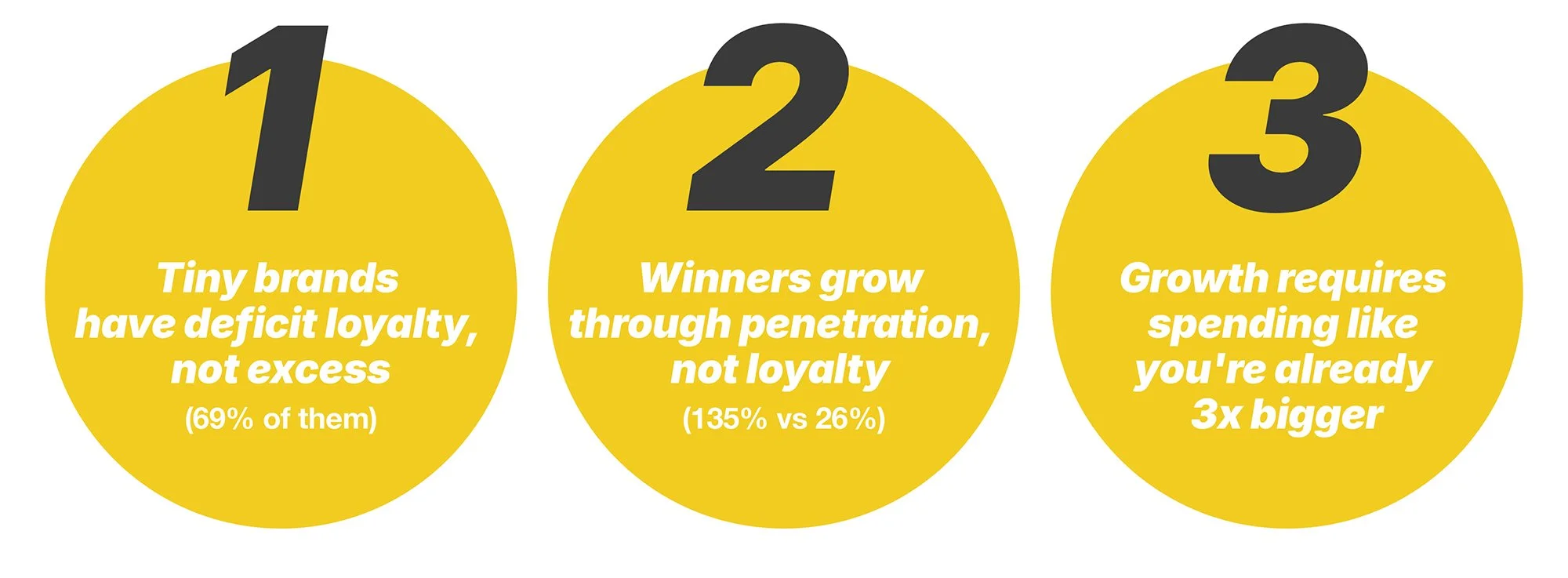
7 out of 10 tiny brands had less loyalty than expected, not more
Nearly half of the "loyal niche" brands with excess loyalty died anyway
This isn't rare. Over half of all brands are tiny. Most are dying slowly without realising it.
Here's what actually happened over those 5 years.
The Grow Fast or Die Reality
The Ehrenberg-Bass Institute’s study shows that 38% of tiny brands vanished within 5 years versus 2% of large brands. A very small percentage of these tiny brands maintained a stable share.
Most importantly, the winners didn’t grow incrementally – they tripled in size, achieving +164% market share growth.
The Physical vs Mental Availability Death Trap
Tiny brands achieve excess penetration, or more loyalty than their size predicts, because getting on shelves is easier than getting into heads. However, without advertising to build memory structures, they get that one-time trial and then are forgotten. With brand memories decaying every 8-16 weeks, that one-time trial becomes a one-night stand. Without budget to refresh those memories through sustained reach, tiny brands become invisible between purchases.
The eSOV Reality Nobody Talks About
What was the secret for the tiny brands that actually grew? They were spending like they were already 3 times bigger. This is a classic eSOV strategy, providing increased penetration but requiring a massing investment in reach/media.
All of this raises the question – where does this money come from?
It’s an uncomfortable answer as it clearly can’t be found through revenue. It must come then from either investors betting on future growth, profitable sister brands subsidising expansion, or founders risking everything. The brands trying to self-fund through "loyal customers"? They're the 38% that vanish.
The Frequency Tax
Dale Harrison took Wanamaker's famous 'half my advertising is wasted' complaint and calculated the actual math. To reach 10,000 people once, you need to pay for 14X frequency. This 'frequency tax' isn't waste - it's the cost of overcoming random distribution and memory decay. Tiny brands trying to be 'efficient' with precise targeting are actually signing their death warrant.
Why Brand Recall at Purchase (BRaP) Matters More Than Ever
Most buyers have a small consideration set in their brand repertoire at the time of purchase. Bigger brands are recalled more frequently for more buyers. With limited reach, tiny brands lose the recency battle every time. It’s a cruel irony. The brands that need reach the most can afford it least.
Self-Reported Brand Awareness (SRBA) Hack: Ask new customers one simple question - 'Did you know about us before you started shopping?' If less than 20% say yes, you have a mental availability crisis that no loyalty program can fix.
The Uncomfortable Implications for Marketers
What's clear is that we need to avoid real waste for brands that already have tiny budgets. The real waste? Niche strategies like targeting heavy buyers or building loyal communities that ignore market laws.
For founders, this study also builds a pragmatic case for the capital requirements for growth. It leaves you with a clear choice of rapid scaling with adequate funding or managed decline.
These patterns also hold for B2B SaaS just as much as consumer goods. Tiny software brands face the same grow-or-die cliff.
The Practical Takeaway
There are a few realistic paths for tiny brands. The first is to raise capital for 2-3 years of eSOV investment. The second is to find a rapidly expanding category where all boats rise.
The research verdict is brutal but clear: tiny brands must grow 3X fast or die slowly. The 'efficient niche strategy' isn't innovative - it's a documented path to becoming one of the 38% that vanish within 5 years. You can't fight the laws of marketing with good intentions and community building. Accept the laws or accept extinction.
For a tiny brand, if you’re not at least seeing incremental growth, you're dying slowly.
Need more BANG for your tiny brand? Let's talk before you become another statistic.